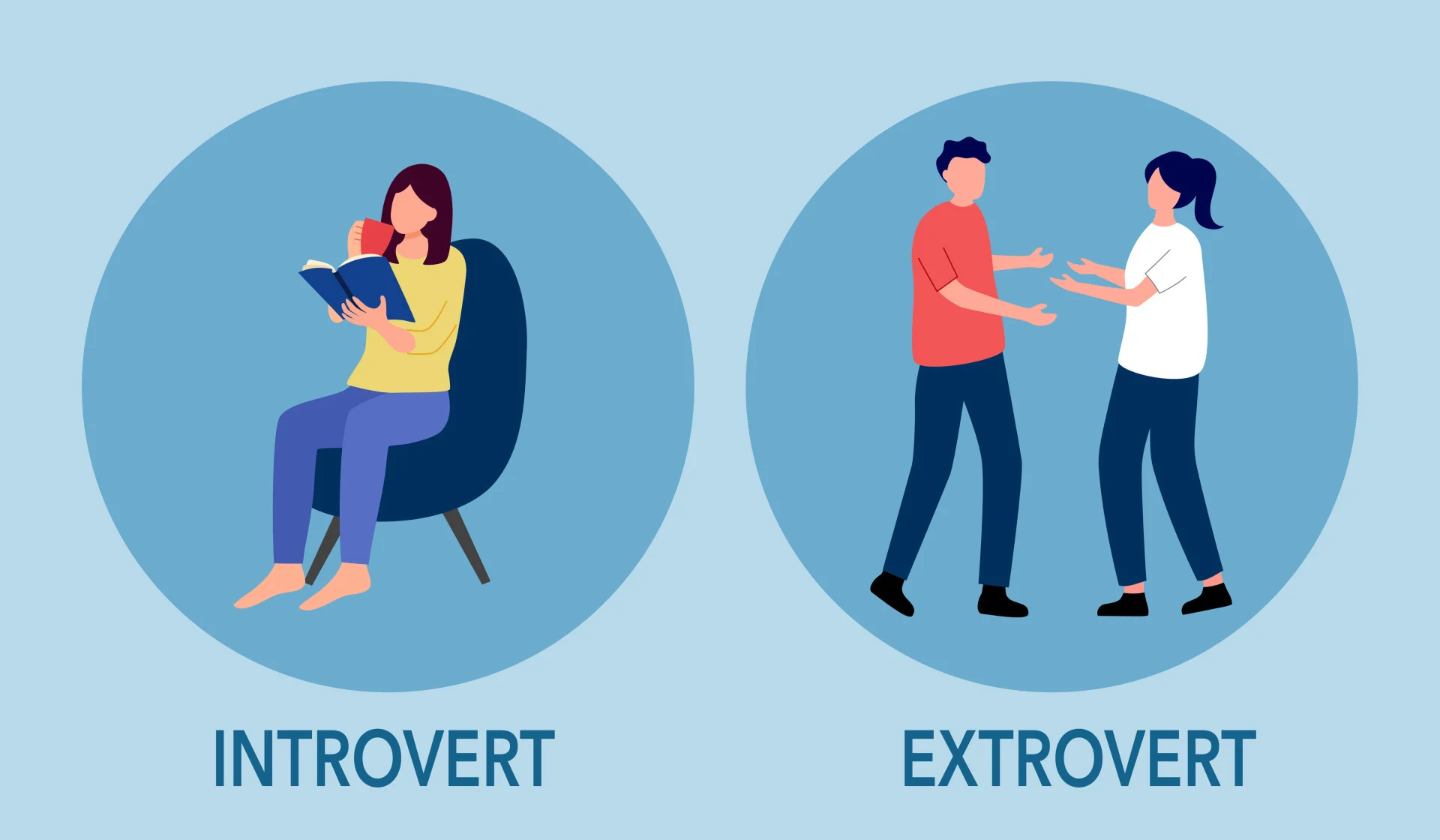
Few ideas in popular psychology have captured as much public imagination — or been more frequently misunderstood — as introversion and extroversion. Described as opposing personality poles, these concepts have become cultural touchstones: ways of explaining ourselves to others, understanding our own needs, and interpreting the behaviour of the people around us.
But what do introversion and extroversion actually mean, according to researchers who study them? And how does the popular understanding diverge from the science in ways that sometimes cause more confusion than clarity?
The Origin of the Idea
The terms introversion and extroversion were popularized in the early twentieth century by the Swiss psychiatrist Carl Jung, who used them to describe fundamental orientations of the psyche — one directed inward toward subjective experience, the other outward toward the external world. Jung's formulation was philosophically rich but abstract, and his influence on what these words came to mean in everyday culture was filtered through many subsequent interpretations.
In contemporary personality psychology, introversion and extroversion are understood primarily as a dimension of the Big Five personality model, labeled "Extraversion." This dimension captures a cluster of tendencies including sociability, assertiveness, positive emotionality, and — perhaps most fundamentally — a responsiveness to environmental reward and stimulation. People higher in extraversion tend to be more responsive to potential rewards, more drawn to social and sensory stimulation, and more likely to experience positive emotions in active social contexts.
Importantly, this means extraversion is not simply about liking or disliking people — a common misconception. It describes a broader orientation toward stimulation, engagement, and reward.
The Energy Metaphor — and Its Limits
The most widely circulated popular explanation of introversion and extroversion is the energy metaphor: introverts recharge in solitude and drain in social situations; extroverts are the opposite. This framing resonates with many people's lived experience, and it's not entirely without basis — but it also has important limitations worth examining.
For one, it positions introversion primarily as a sensitivity to overstimulation, which is only part of what research shows. It can also inadvertently suggest that social situations are inherently costly for introverts, when in reality many introverted people greatly enjoy connection and relationships. They may simply find large or high-stimulation gatherings more draining, or require more recovery time afterward — which is not the same as disliking people.
"Introversion isn't a social deficiency — it's a different relationship to stimulation. And that difference shapes far more than where you'd rather spend a Friday evening."
The energy metaphor also risks pathologizing introversion by framing it as a kind of deficit — a battery that drains faster. This misses the genuine strengths that research consistently associates with introversion: a tendency toward careful, sustained attention; often more thoughtful listening in conversations; depth over breadth in interests; and a comfort with solitude that supports certain kinds of creative and intellectual work.
What the Research Shows
Decades of personality research have produced fairly consistent findings about how this dimension shows up in everyday behaviour. People higher in extraversion tend to report more frequent positive emotions in social contexts. They tend to be more talkative, more assertive in group settings, more likely to initiate conversations with strangers, and more responsive to external rewards and novelty.
People lower in extraversion — more introverted — tend to prefer fewer but deeper social connections. They often do better with focused, uninterrupted work. They tend to think before speaking rather than thinking aloud, which can make them seem more reserved in group settings. Research also suggests introverts process information more thoroughly before responding, which can be a genuine cognitive asset in situations requiring careful analysis.
It's worth noting that neither profile predicts overall wellbeing, professional success, or the quality of one's relationships. Both orientations come with genuine strengths and genuine challenges, and which matters more depends enormously on circumstances, culture, and the specific demands of a person's life.
The Ambivert Reality
One of the most important — and underappreciated — aspects of the introversion-extroversion dimension is that most people don't sit at the extremes. The distribution of extroversion scores across large populations forms something close to a bell curve, meaning the majority of people fall somewhere in the middle, often called the ambivert range.
Ambiverts draw on both orientations depending on context. They may feel energized by social gatherings in some circumstances and genuinely depleted in others. They can be assertive and outgoing when a situation calls for it, and reflective and reserved when that seems more appropriate. This contextual flexibility is not the same as having no stable personality — it's a genuine and adaptive personality style in its own right.
The cultural tendency to treat introversion and extroversion as binary opposites — "I'm an introvert" or "I'm an extrovert" — obscures the reality that most people navigate a spectrum, and that position on that spectrum can shift somewhat across life stages, relationships, and environments.
Introversion, Extroversion, and Culture
It's impossible to discuss this dimension without acknowledging that different cultures value introversion and extroversion very differently. Many Western cultures — and particularly North American professional environments — have historically favoured extroverted traits: speaking up, taking initiative, commanding social presence. Susan Cain's widely read book "Quiet" drew significant attention to what she called the "extrovert ideal" embedded in much of American cultural and workplace life.
But this is not a universal pattern. Research suggests that cultures vary considerably in how they weight extroversion and introversion, and in some East Asian contexts, more reserved and reflective behaviour is culturally associated with wisdom and social competence rather than shyness or lack of confidence.
This has practical implications. A quiet, reflective person in an environment that rewards loudness and constant social engagement may spend considerable energy performing extroversion — what researchers call "acting extroverted" — in ways that are effortful and draining. Understanding that this is a cultural mismatch, not a personal deficiency, can be genuinely relieving.
In Relationships and Work
The introversion-extroversion dimension shows up clearly in how people prefer to work and how they navigate close relationships. At work, extroverts often thrive in open-plan offices, collaborative settings, and roles that involve frequent social interaction. Introverts frequently do their best work with dedicated quiet time, clear boundaries around interruption, and opportunities to prepare before contributing to group discussions rather than being put on the spot.
In romantic partnerships, the introvert-extrovert dynamic is one of the most commonly cited sources of low-level friction. The extroverted partner may experience the introverted partner's desire for a quiet weekend at home as withdrawal or disinterest, while the introverted partner may experience the extroverted partner's social agenda as exhausting or invasive. Neither is making an unreasonable request — they're simply operating from different baseline needs.
Couples who navigate this well tend to develop explicit agreements rather than relying on implicit expectations: how often they socialize with others, how much alone time is built into shared time, how they signal when one partner needs recovery. These conversations are easier when both people understand that the difference reflects personality, not preference for each other's company.
Can Introversion or Extroversion Change?
Research suggests that extraversion is among the more stable personality traits across adulthood, but "stable" doesn't mean "fixed." Some studies have found modest average increases in extroversion over the lifespan in some populations, and meaningful individual variation does occur — particularly in response to major life changes like moving to a new city, beginning a demanding career, or entering a long-term relationship.
There's also evidence that people can deliberately act more extroverted when they choose to — presenting in a meeting, taking a social initiative, engaging more assertively in a conversation — and that doing so doesn't necessarily feel as unnatural as many introverts expect it to. The key word is "choose": acting extroverted situationally is different from being extroverted as a baseline orientation, and the former requires more effort and recovery time for introverts even when it goes well.
This distinction matters for the widespread cultural pressure some introverts feel to become more extroverted. There's a meaningful difference between developing social skills and communication abilities — which most introverts can do very effectively — and genuinely changing one's fundamental orientation toward stimulation and social reward, which is a much harder proposition and probably not a worthwhile goal.
What This Means for Self-Understanding
Understanding your own place on the introversion-extroversion spectrum — even approximately — can offer some genuinely useful practical insight. Not in the sense of justifying every preference as fixed and immovable, but in the sense of making better decisions about how you design your days, your work environments, and your social commitments.
If you consistently feel drained after large social gatherings, building in recovery time isn't weakness — it's sensible self-management. If you find that you do your clearest thinking in conversation rather than solitude, designing more of your thinking time around dialogue isn't a crutch — it's working with your cognitive tendencies rather than against them.
The same logic applies at a relationship level. If you understand that a partner, friend, or colleague processes differently than you do — needs more alone time, or more social engagement, or more conversation before making decisions — you're in a better position to navigate those differences with curiosity rather than frustration.
This, ultimately, is the most practical value of personality frameworks: not as destiny, not as limitation, but as a starting point for self-knowledge that makes daily life a little more legible and a little less effortful.
A Balanced Closing Thought
The introversion-extroversion spectrum is a genuinely useful lens for understanding human variation — but it's one lens among many, and personality is only one of the many things that shape who a person is and how they move through the world. Social context, upbringing, culture, habit, life stage, and the specific demands of any given situation all interact with personality in ways that make any simple label incomplete.
The goal isn't to determine once and for all whether you're "an introvert" or "an extrovert" — it's to notice, with genuine curiosity, what energizes and depletes you, what kinds of connection you find nourishing, and how you can build a life that works with rather than against your natural inclinations. That kind of self-understanding is an ongoing project, not a quiz result.
This article is written for general interest and personal reflection. Research references are drawn from the personality psychology literature and presented accessibly for non-specialist readers. This content is not a clinical resource and does not constitute professional advice.